
Bathroom Light Guide 2026: How to Choose the Right Fixture for Every Zone
Most bathroom renovations spend hours choosing tile and fixtures, then treat lighting as an afterthought — a single overhead fixture picked in the last five minutes at the store. That’s usually where things go wrong. The right bathroom light setup isn’t about one fixture; it’s about layering different types of light so the room works for grooming, safety, and mood, all at once.
Electricians who work on bathroom remodels regularly point to the same recurring issue: homeowners get a bathroom that looks fine in photos but casts harsh shadows at the mirror every morning. This guide walks through how to actually get bathroom lighting right — by function, placement, material, and installation — so you avoid that exact problem.
Why Bathroom Lighting Needs More Thought Than It Gets
A bathroom light isn’t just about brightness. It typically has to serve three distinct jobs at once:
- Task lighting — focused illumination for shaving, makeup, and skincare, where shadows can genuinely distort what you see in the mirror
- Ambient lighting — general room brightness that makes the space safe to move around in, especially on wet floors
- Accent lighting — highlighting design features like a niche, mirror frame, or architectural detail
Trying to cover all three with a single ceiling fixture is the most common reason bathrooms feel either too dim for grooming or too harsh for relaxing.
The Main Types of Bathroom Lights
| Fixture Type | Best Use | Key Consideration |
|---|---|---|
| Ceiling/flush-mount | General ambient light | Broad but often shadow-prone alone |
| Wall sconces | Beside or above the mirror | Reduces facial shadows better than overhead light |
| Recessed lighting | Above showers or tubs | Must be moisture-rated for wet zones |
| LED strips | Under cabinets, behind mirrors | Great for accent lighting, not sole light source |
| Pendant lights | Larger bathrooms, focal points | Adds style but limited task coverage |
| Smart lights | Any zone | Adjustable brightness and color temperature via app |
The detail most people miss: sconces placed beside a mirror at eye level do far more for grooming visibility than a single fixture mounted above it, because side lighting avoids the downward shadows that a top-mounted light creates across the face.
Placement: Where Light Actually Goes vs. Where It Should Go
Placement is arguably more important than fixture choice. A few principles hold up across almost every bathroom layout:
- Over the mirror isn’t always the best spot. Vertical sconces on either side of the mirror, at roughly eye level, distribute light more evenly across the face than a single horizontal bar above it.
- The ceiling center handles ambient light, not task lighting — it’s there to make the room safe to navigate, not to help you see fine detail up close.
- Near the shower or tub, only moisture-rated fixtures should go in. This isn’t optional; it’s a safety requirement, not just a design preference.
- Layering beats a single strong source. Combining ambient, task, and accent lighting avoids the “too dim in one spot, too bright in another” problem that a single fixture almost always creates.
Natural light changes this equation too. A bathroom with good window placement needs less artificial daytime lighting — which is one more reason layout decisions for windows and lighting work best when planned together rather than separately. If you’re mapping out your bathroom’s light sources as a whole, our guide to bathroom windows covers how natural light placement affects the rest of the room.
Materials That Actually Hold Up in a Bathroom
Humidity is the real test for any bathroom fixture, and materials that look identical in a showroom often perform very differently after a year of steam and moisture exposure.
- Stainless steel and aluminum resist rust and are a safe default for most fixtures in humid rooms.
- Frosted or textured glass softens harsh bulb glare while still providing solid task lighting.
- Plastic or acrylic fixtures are lightweight and budget-friendly, though generally less durable long-term than metal.
- Waterproof seals and corrosion-resistant hardware matter most for anything mounted near a shower or tub — this is where cheap hardware fails first.
Skipping moisture-rated materials in wet zones is one of the most common — and most expensive to fix — mistakes in bathroom lighting projects.
Installing a Bathroom Light Safely
Because bathroom lighting sits at the intersection of water and electricity, installation isn’t a place to cut corners.
- Shut off power at the breaker before touching any wiring — every time, no exceptions.
- Check existing wiring capacity, especially if you’re adding fixtures to a circuit that also powers other bathroom outlets.
- Use moisture-rated fixtures for anything installed near a shower, tub, or sink.
- Follow manufacturer installation instructions to keep warranty coverage valid.
- Hire a licensed electrician for anything beyond a simple fixture swap — especially wiring changes or smart-control integration.
- Test thoroughly after installation: check brightness, dimmer function, and confirm there are no exposed connections near moisture sources.
A poorly installed fixture in a wet zone isn’t just an inconvenience — it’s a genuine electrical hazard, which is the one area of this project where DIY shortcuts carry real risk.
Design Choices That Change the Whole Room
Once function is sorted, design decisions shape how the bathroom actually feels:
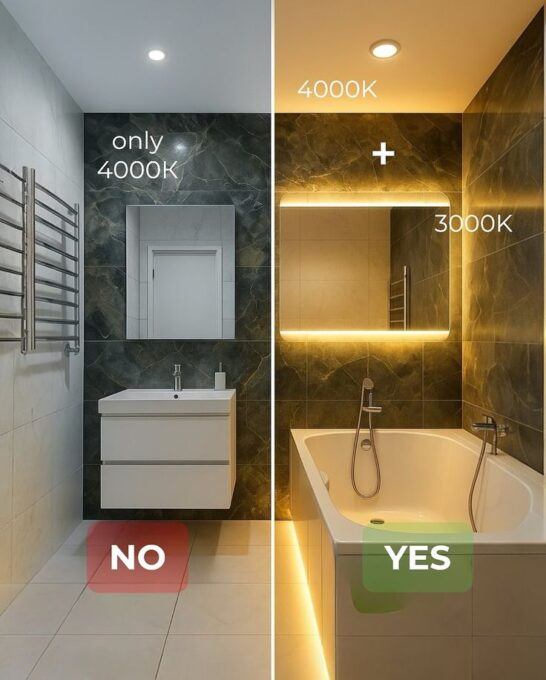
- Color temperature matters more than people expect. Warmer light (around 2700K–3000K) feels more relaxing and flattering; cooler light (4000K and above) improves precision for tasks like makeup application.
- Fixture finish should coordinate with faucets, cabinet hardware, and mirror frames rather than being chosen in isolation.
- Glass diffusion type — frosted, textured, or clear — changes both light quality and how much fixture detail is visible.
- Scale matters. An oversized pendant can dominate a small bathroom, while an undersized fixture gets lost in a larger one.
The Illuminating Engineering Society generally recommends layering light sources at different heights rather than relying on a single ceiling fixture — a principle that consistently shows up in well-reviewed bathroom lighting plans.
Energy Efficiency: What Actually Moves the Needle
LED lighting has made efficiency gains standard rather than optional, but not all LED fixtures perform equally.
According to ENERGY STAR, certified LED bulbs use significantly less energy and last far longer than incandescent bulbs, while producing comparable or better light quality — making certification a reliable way to compare efficiency claims between fixtures.
Beyond bulb choice, dimmers and motion sensors reduce unnecessary energy use in a room that’s often lit at full brightness even for a 30-second trip to the sink at night.
Maintenance: The Small Habits That Prevent Bigger Problems
Bathroom lighting takes more of a beating than lighting anywhere else in the house, simply because of constant humidity exposure.
- Clean fixtures regularly to remove dust, water spots, and soap residue that dull brightness over time
- Inspect wiring and fixture integrity periodically, especially on older installations
- Replace bulbs following manufacturer specifications to avoid overheating fixtures rated for lower wattages
- Check seals on wet-zone fixtures at least once or twice a year
- Ventilate after showers to reduce the moisture load fixtures are exposed to daily
None of this is complicated, but skipping it consistently shortens fixture lifespan and can lead to dimming or flickering well before a bulb would normally need replacing.
Frequently Asked Questions
What’s the best light placement for applying makeup? Vertical sconces at eye level on either side of the mirror generally outperform a single overhead fixture, since they minimize the shadows that distort facial detail.
Can I install any light fixture near my shower? No — fixtures near showers or tubs need a moisture rating appropriate for that wet zone; standard fixtures aren’t rated for that level of humidity exposure and can pose a safety risk.
What color temperature works best for a bathroom? Warmer temperatures (2700K–3000K) feel more relaxing for general use, while cooler temperatures (4000K+) improve precision for detailed grooming tasks — many bathrooms benefit from combining both.
Do I need an electrician for a simple fixture swap? A straightforward like-for-like replacement can sometimes be done without one, but any wiring changes, new circuits, or fixtures near wet zones should involve a licensed electrician.
How often should bathroom light fixtures be cleaned? Regularly — dust and water spots dull brightness faster in a bathroom than almost anywhere else in the home, so monthly cleaning is a reasonable baseline.
Final Thoughts
A well-lit bathroom isn’t the result of one good fixture — it’s the result of layering ambient, task, and accent lighting so each zone of the room gets what it actually needs. Prioritize moisture-rated materials near wet areas, place task lighting at eye level rather than overhead, and don’t treat efficiency as an afterthought — certified LED options now deliver better light quality with a fraction of the energy cost of older fixtures.
Get those fundamentals right, and even a modest bathroom lighting budget can outperform a more expensive setup that skipped the planning stage.