
How to Ventilate a Bathroom Without a Window
Windowless bathrooms are common enough in apartments and compact homes that most people eventually deal with one, but that doesn’t make the moisture problem any less real. How to improve bathroom ventilation without a window comes down to one core challenge: steam and humidity that would normally escape through an open window instead have nowhere to go, which sets the stage for mold, lingering odors, and slow damage to paint, grout, and ceilings if nothing intervenes.
This guide covers the mechanical and passive solutions that actually work, how to combine them for the best results, and the small daily habits that determine whether a windowless bathroom stays genuinely dry or just looks that way until the next shower.
Why This Problem Is Worse Than It Looks
Every hot shower releases a meaningful amount of water vapor into the air. In a room with a window, some of that moisture escapes naturally. Without one, it has nowhere to go, and the humidity lingers far longer than most people expect — often well after the bathroom “feels” dry to the touch.
That extended dampness creates a chain of problems worth understanding before jumping to solutions:
- Condensation settles everywhere — mirrors, tile grout, and even inside cabinets — and takes far longer to evaporate than it would with airflow.
- Mold and mildew find ideal conditions. Warm, consistently humid air is exactly what mold needs to establish itself, and once it does, it tends to spread faster than expected and can trigger respiratory irritation in sensitive individuals.
- Odors don’t dissipate. In a closed, poorly ventilated space, smells linger and build up over time rather than clearing out on their own.
- Materials degrade. Paint peels, wood swells and warps, grout weakens, and ceilings develop stains — problems that start as “just humidity” but can turn into genuine repair costs if left unaddressed for months or years.
Exhaust Fans: The Most Reliable Fix
If there’s one solution that consistently outperforms everything else, it’s a properly installed exhaust fan.
How It Actually Works
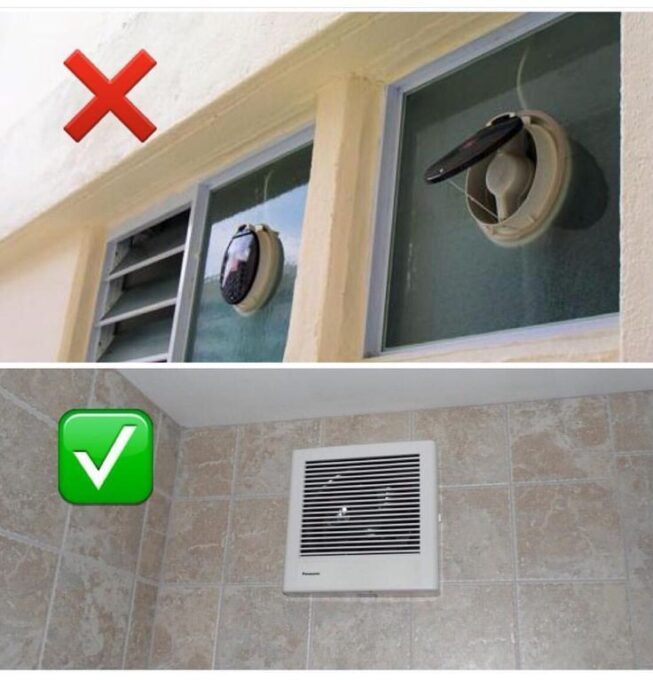
An exhaust fan pulls humid air out of the bathroom and vents it outside through ductwork, creating continuous airflow that prevents moisture from settling and accumulating in the first place. This is fundamentally different from just moving air around a closed room — the moisture actually leaves the building rather than just relocating to another surface.
Why It Outperforms Other Options
- It reduces humidity quickly, often within minutes of running.
- It prevents condensation from forming on mirrors, tile, and ceiling surfaces.
- Modern models can run automatically based on humidity sensors, removing the need to remember to turn it on and off manually.
Getting the Installation Right
A poorly installed fan underperforms no matter how good the unit itself is.
- Position it near the shower or tub, where moisture concentration is highest.
- Size it correctly for the room. Fan capacity is measured in CFM (cubic feet per minute), and an undersized fan simply won’t move enough air to keep up with a typical shower’s steam output.
- Confirm the ducting actually vents outside, not into an attic or crawl space — venting into an enclosed area just relocates the moisture problem rather than solving it.
- Run it during and after showers, not just during. Moisture continues evaporating off wet surfaces for a while after the water’s turned off.
Passive Airflow Strategies Worth Combining With a Fan
Mechanical ventilation does the heavy lifting, but a few passive habits meaningfully add to the effect, especially in bathrooms where fan installation isn’t immediately possible.
- Leave the door slightly open after showering, if privacy allows. Even a small gap lets humid air escape and drier air from the rest of the home circulate in.
- Take advantage of cross-ventilation. If a nearby room has a window, keeping doors open between spaces lets airflow move through the bathroom on its way through the home.
- Consider a passive vent built into the door or an interior wall. These small, code-compliant vents allow continuous air exchange between the bathroom and adjacent spaces without needing to leave the door open at all times.
None of these fully replace an exhaust fan, but combined consistently, they noticeably reduce how long humidity lingers.
Dehumidifiers as a Supplemental Tool
A dehumidifier pulls moisture directly out of the air and stores it in a reservoir, which makes it a genuinely useful addition in bathrooms that stay damp even with decent airflow.
Best used: right after a shower, during particularly humid weather, or in bathrooms that seem to stay damp no matter what other steps are taken.
What to look for: a compact model with automatic shut-off and adjustable humidity settings tends to offer the best balance of convenience and actual effectiveness for a small bathroom.
Used together, a fan and a dehumidifier cover both sides of the problem — active removal of moist air and ongoing reduction of ambient humidity between uses.
Small Tools That Improve Air Movement
Beyond exhaust fans and dehumidifiers, a few simple additions help air actually move through the space rather than sitting still.
| Tool | What It Does | Best For |
|---|---|---|
| Portable fan | Circulates air, speeds up surface drying | Bathrooms without ceiling fan space |
| Ceiling fan | Distributes airflow evenly across the room | Larger windowless bathrooms |
| Air purifier | Reduces odors and improves overall air quality | Persistent smell issues alongside humidity |
Materials That Handle Moisture Better
What the bathroom is actually built from matters just as much as how the air moves through it. Some surfaces simply hold up better in a consistently humid environment.
- Ceramic or porcelain tile resists water damage and dries quickly compared to more porous materials.
- Waterproof or moisture-resistant paint holds up far longer than standard interior paint in a room that stays humid regularly.
- PVC or vinyl surfaces are practical, low-maintenance choices for areas that see frequent direct water exposure.
Choosing the right surface material genuinely reduces long-term maintenance in a windowless bathroom, since these materials dry faster and simply don’t absorb and hold moisture the way more porous options do.
Smart Technology Options
Ventilation has gotten noticeably more automated in recent years, which helps solve the most common failure point: forgetting to run the fan long enough, or at all.
- Smart exhaust fans activate automatically once humidity crosses a set threshold, removing the guesswork entirely.
- Humidity sensors paired with a fan or dehumidifier allow real-time monitoring, so the system responds to actual conditions rather than a fixed timer.
- Dual systems — an exhaust fan combined with a dehumidifier, both triggered by the same sensor — tend to produce the most consistent results for bathrooms that struggle with humidity even with basic ventilation in place.
How Bathroom Humidity Affects the Rest of the Home
Moisture generated in a windowless bathroom doesn’t always stay contained to that one room. It can work its way into adjacent walls, ceilings, and even shared ventilation paths, which means unmanaged humidity has consequences well beyond the bathroom itself — paint damage, warped wood, and reduced insulation efficiency can all show up in neighboring spaces over time. This is part of why the CDC includes indoor humidity and mold prevention in its broader guidance on healthy indoor environments, since the health and structural effects genuinely extend past the room where the moisture originates. The CDC’s guidance on mold and dampness is a solid, evidence-based reference for anyone wanting to understand the health implications more thoroughly.
Common Mistakes That Undermine Good Ventilation
| Mistake | Consequence | Fix |
|---|---|---|
| Turning the fan off too soon | Moisture continues evaporating off wet surfaces | Run it 15–20 minutes after showering, not just during |
| Venting into an attic instead of outside | Moisture problem just relocates | Confirm ducting actually exits the building |
| Relying only on air fresheners | Masks odor without addressing the moisture causing it | Address humidity directly, treat scent as secondary |
| Undersized fan for the room | Insufficient airflow to keep up with steam output | Match fan CFM rating to the bathroom’s actual size |
| Keeping the door fully closed at all times | No opportunity for passive air exchange | Crack the door when privacy isn’t a concern |
Frequently Asked Questions
Is an exhaust fan alone usually enough? For most windowless bathrooms, yes, as long as it’s sized correctly and run long enough after each shower. Bathrooms that stay unusually damp even with a good fan often benefit from adding a dehumidifier as well.
Can I improve ventilation without installing any electrical devices? To some extent. Leaving the door cracked, encouraging cross-ventilation from nearby rooms, and installing a passive wall or door vent all help, though the results are noticeably more limited than what a mechanical fan provides.
How long should ventilation run after a shower? Roughly 15 to 20 minutes is generally enough to clear residual moisture from the air and allow surfaces to finish drying, though larger bathrooms or longer showers may need a bit more time.
What’s the most common mistake people make with windowless bathroom ventilation? Turning the fan off immediately after the shower ends, rather than letting it run afterward. Surfaces continue releasing moisture into the air for a while even after the water’s off.
Do I need a professional to install an exhaust fan, or is this a DIY project? Basic fan replacement in an existing duct location is often manageable for someone comfortable with minor electrical work. Adding new ductwork or venting to the exterior for the first time is generally worth having a professional handle, since incorrect venting can create moisture problems elsewhere in the home.
Are dehumidifiers necessary if I already have a good exhaust fan? Not always, but they’re a worthwhile addition for bathrooms that stay damp longer than expected, or in climates with generally high ambient humidity where a fan alone struggles to keep up.
Final Thoughts
A windowless bathroom isn’t a permanent moisture problem — it just requires a bit more intentional ventilation than a room with natural airflow already built in. A correctly sized exhaust fan run long enough after each shower solves most of the issue on its own, and layering in passive airflow habits, moisture-resistant materials, and a dehumidifier where needed covers the rest. For readers tackling other overlooked but important parts of the home, our guide on vertical garden ideas for small spaces covers a different kind of space-conscious upgrade, but the same underlying principle applies: a bit of planning goes further than most people expect.